The Case of the Kneaded Recipe Card
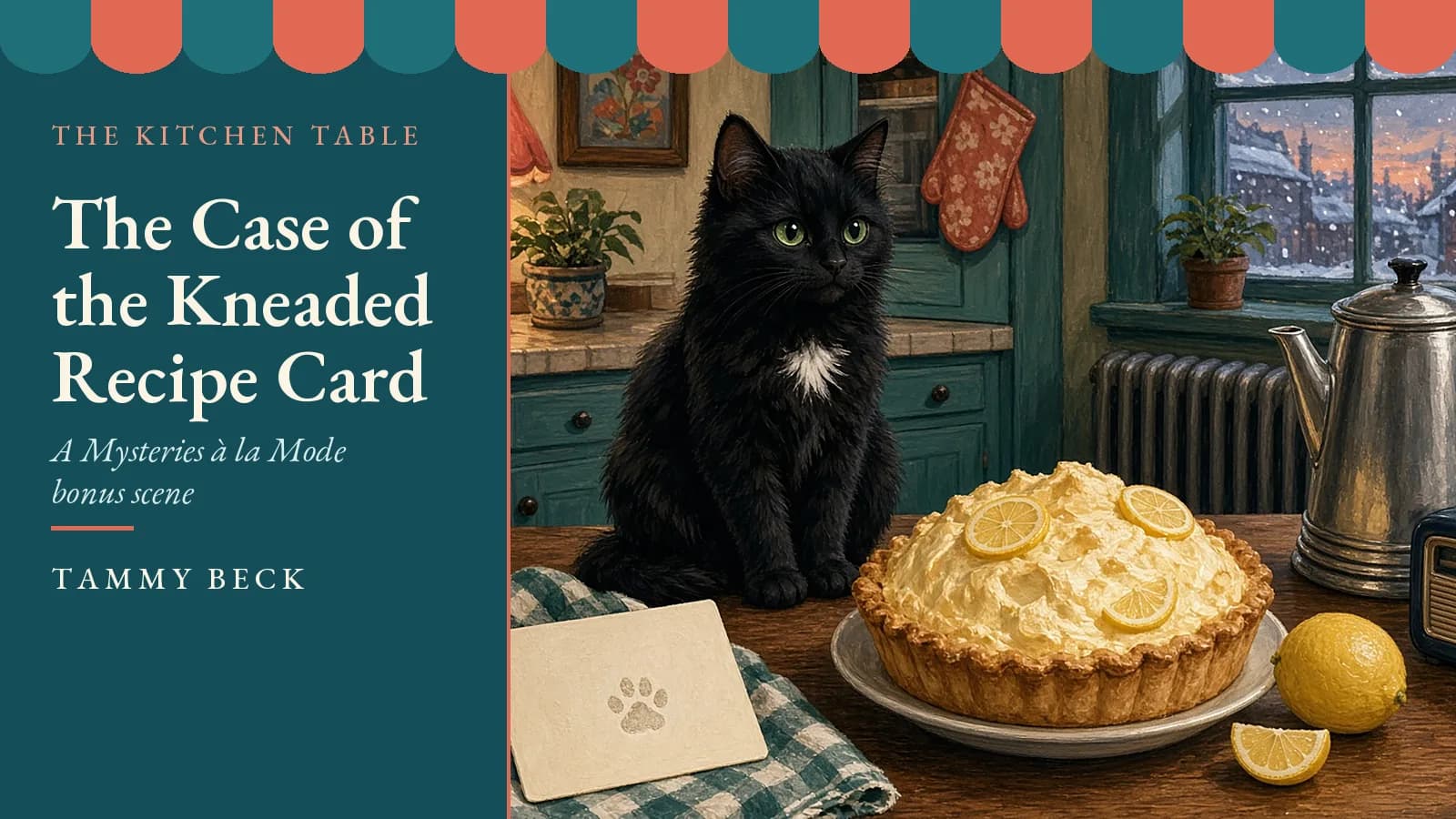
A little moment from Francis's kitchen, after the bakery opened.
Scene 1: Testing Day
By the time we closed Appetite Bakery, the windows had gone dark and the cold had settled in for the night.
We went around through the courtyard, along the path shoveled through the snow, and up the narrow wooden steps to my apartment. The steps had been swept clear, with snow banked on either side, but a thin frost had already formed on the treads, and our shoes left prints on every one. Dottie came behind me, carrying a recipe card in both hands, the way some people carry a full cup of coffee.
“It won’t spill,” I said.
“It isn’t mine.” She held it a little tighter. “A lady I know lent it to me. She wants it back Sunday. I thought I’d take it home tonight and copy it, if we like it.”
She hesitated, then said the rest all at once. “And if it’s good, I thought it might go in the case downstairs. Something bright, for the cold weeks. If you think so. You don’t have to think so.”
I smiled. “I love experimenting and we need a special for next week. Let’s find out.”
Mittens met us at the door and inspected us both.
“Hello sweetheart,” I said, scratching her behind the ear. “Long day protecting the apartment?”
She leaned into my hand a moment before she sniffed the sack of lemons we’d brought along, found it acceptable, and walked ahead of us into the kitchen with her fluffy black tail held high. The little white splash on her chest caught the light like a napkin tucked in for dinner.
I switched on the kitchen light and put the percolator on. Some things come before pie.
Dottie tucked a stray red strand back into her bun, tied on her apron and smoothed the card flat on the counter. Lemon Chiffon Pie, it said, in a slanting hand.
“Are you sure you don’t mind?” she asked. “It’s your kitchen.”
“It’s a kitchen,” I said. “It doesn’t mind who uses it, as long as they wipe the counters.”
She ducked her head and smoothed the card again. Dottie was always a little shy until her hands were busy. Once they were, she had opinions.
I started on the pastry shell. I measured the flour into the cup, then leveled it with the back of a knife, the way I always did.
“You know it comes out the same if you just shake it,” Dottie said.
“It comes out roughly the same. And that’s how pies end up in the sink,” I said, and reached for the salt.
We switched on the old transistor radio and “Mack the Knife” filled the kitchen. I swayed to the beat and Dottie hummed along. Mittens had found a spot on the kitchen table and closed her eyes, appreciating the music, too.
Once the dough had rested its half hour in the refrigerator, I rolled it out and put the shell in the oven. While it baked, Dottie grated the rind of one lemon over a saucer, then squeezed it and two more for the juice, until the whole kitchen smelled of lemon. I set out what we would need: the mixing bowls, a stack of paper napkins, and a row of clean teaspoons along the edge of the counter.
The teaspoons were for tasting, not measuring. Dottie would measure it roughly in the palm of her hand.
I cooked the yolks, the sugar and the lemon juice over simmering water, stirring and watching, and she stood at my elbow. She tasted when it was thin. She tasted again when it was thicker. She tasted after I stirred in the gelatin. Each time she took a fresh spoon from the row, and each time the used one went into the sink.
“I was trained,” she said, when she caught me counting. “We were never allowed to taste twice with the same spoon.”
“You’ve used seven spoons.”
“Six. The first one was a sniff.”
Around the sixth spoon, Mittens decided she had been left out long enough.
She arrived on the counter without a sound and went straight for the tea towel. She kneaded it thoroughly with both front paws, purring, then hopped down with a corner of it in her mouth and dragged it off to the living room, to her warm spot by the radiator.
Dottie went after her and came back with the towel over her arm. “That’s for drying the dishes,” she told the cat, very politely. “Not for you.”
Mittens returned a minute later and looked at her the way a librarian looks at someone who has returned a book with a bus ticket still inside it.
Then she went exploring. Dottie had nudged the sugar bowl while reaching for a spoon, and there was a small white drift of sugar across the tiles, mixed with the flour I hadn’t yet wiped from the pastry board. Mittens walked straight through it, then across the counter, leaving a neat line of white paw prints.
“Look,” Dottie said. “She’s got socks.”
“She’s got my flour.”
Mittens sat down on the recipe card with her tail curled over the ingredients and her green eyes half closed. Dottie slid it out from beneath her an inch at a time.
I lifted Mittens off the counter and set her on the floor.
“Let us work, old girl.” She stalked off toward the front door, leaving a trail of floury prints across the boards, offended in every step.
Dottie folded the towel into a neat square at the far end of the counter, by the window. Then she laid the recipe card on it and folded one corner over, like an envelope.
“There,” she said. “Out of the flour.”
The filling went into the refrigerator to chill, and the baked shell was left to cool. It needed to thicken until it mounded on a spoon, and no longer, before the beaten whites went in. I set the timer for half an hour. Then I measured the sugar for the whites into a teacup and set it beside the mixing bowl.
Dottie watched me do it. “You measured that already?”
“I measure things beforehand,” I said. “It saves time later.”
We sat with our coffee while the timer ticked. Mittens had come back up onto the counter at some point and was washing her paws, one and then the other, getting rid of all the flour and sugar evidence.
When I got up to rinse the grater, I dried my hands on my apron.
Someone knocked on the bakery door downstairs. The door was right below the kitchen windows, or we might not have heard it.
“That would be Ed for his cinnamon rolls,” Dottie said. “I’d bet you anything. There was a box left under the counter that he didn’t collect after work as usual.”
We hurried down and let ourselves into the bakery by the back door. Dottie had guessed right.
“I can’t go to bed without my evening fix, Francis,” Ed said apologetically. “I thought I’d take a chance.”
“I wouldn’t dream of letting you waste away after a long day at the station,” I said with a chuckle. It took a few minutes for Dottie to find the box.
“Can I give you something extra for the trouble?” Ed asked.
“Of course not,” I said, waving my hand.
Ed tried to insist, but we sent him off with his cinnamon rolls, only making him promise to keep our town as safe and cozy as it was.
When we came back up, Dottie went straight to the far end of the counter to fetch the card for the whites.
“Francis!” she cried out a moment later. “It’s…. It’s gone!”
“What?” I asked.
“The recipe card. And the towel! I left it right here.”
She pointed at the empty spot. There was no card.
And we hadn’t done the meringue yet.
Scene 2: The Case of the Kneaded Recipe Card
“It was right there,” Dottie said. “I put it right there.”
“You did,” I said. “I watched you.”
“She wants it back Sunday.” Her voice went small. “It isn’t even mine to lose.”
“Then we won’t lose it,” I said. “The towel is gone with it, and that’s not easy to overlook. Whatever happened, this apartment isn’t big enough for either of them to go far.”
I had been a librarian long enough to know that books go missing all the time, and almost none of them have been stolen. They have been misshelved, left under a chair, or tucked into the wrong pile by someone with good intentions.
“The trick is not to panic,” I told Dottie. “The trick is to observe, catalog and cross-reference.”
The timer said ten minutes. Not long after it rang, the filling would set too firm to take the whites at all.
We had to observe quickly.
“Somebody could have come up while we were downstairs,” Dottie said. “We left the door unlocked.”
“There was frost on every step,” I said, “and the only footprints were ours.”
“Then the draft took it,” Dottie muttered. “I knew I should have–”
“The napkins are still here,” I cut her off. “A draft that could carry off a recipe card and a tea towel would have taken a napkin first. Napkins are much less determined.”
Dottie looked at the napkins. “All right,” she said. “Not the draft.”
“There is also,” I said, as gently as I could, “the matter of a person who wanted to take that card home tonight.”
Dottie stared at me. Then, with enormous dignity, she turned out both pockets of her apron.
The left pocket held nothing. The right held a teaspoon.
We both looked at the teaspoon.
“It’s clean,” she said. “It was the last one. I was saving it for the meringue.”
“Of course.”
“I didn’t take the card, Francis.”
“I know,” I said. “But a good investigation clears its suspects in order. You’re cleared. Your spoon is still under some suspicion.”
She set the spoon down, a little pink about the ears, and pointed at the floor. “Then it was her.”
The white prints ran from the counter across the boards toward the front door. On paper, the case was strong.
I crouched beside them. They were smudged, and across the middle of the trail ran the print of a shoe. Ours. We had walked straight through them on the way out.
“These were here before we went downstairs,” I said. “She made them when I put her off the counter. They tell us where she went then, not after.”
Eight minutes.
I stood up and went back to the bare patch of counter by the window, where the card and the towel had been. Then I looked down at my apron.
“I dried my hands on this before the knock,” I said slowly. “Not on the towel. The towel was already gone, and I didn’t notice. If the card went with the towel, it went before we ever went downstairs.”
“Then where is it?” Dottie cried out, her panic climbing.
I thought of Mittens planted squarely on the card earlier, and of her working at the towel with both paws. She never simply lay down anywhere. She arranged things first.
“She doesn’t run off with things,” I said. “She makes a bed of them.”
I bent down again and looked along the floorboards toward the living room, with the lamplight behind me. There it was, hardly more than a dusting: a faint, fresh line of prints, made by paws that had very nearly been washed clean.
Dottie followed me in.
On the rug by the radiator lay my tea towel, gathered into a lumpy little nest. In the middle of it, fast asleep, lay Mittens. Only the white splash on her chest and her paws showed, rising and falling, as innocent as a freshly laundered collar.
Under one ear, folded nearly in half and kneaded soft as flannel, was the corner of a recipe card.
“Oh,” Dottie breathed. “Oh, you little rascal!”
I eased the card out a quarter-inch at a time. Mittens opened one green eye, judged the matter not worth waking for, and closed it again.
The card had survived, creased and warm. Across the method, in flour, sat a single round paw print.
It had landed right on the line that said how much sugar went into the whites.
Dottie squinted at it. “Is that a half? A third? It might be a cat.”
“It’s a half,” I said.
“How can you possibly know that?”
I went back into the kitchen and picked up the teacup of sugar I had measured before we ever heard the knock.
“You measured the meringue sugar,” she said, “before the meringue.”
“I told you. It saves time later. And uncertainty, it turns out.”
The timer went off. Dottie beat the whites while I added the sugar a little at a time. When the filling came out of the refrigerator, it mounded exactly as it should. We folded the two together, gently, and piled the whole cloud of it into the shell. It looked like a snowdrift that had decided to be dessert.
There was too much filling, as there always is, so the rest went into two custard cups. The pie went back into the refrigerator to set overnight. The custard cups were ours.
While we waited for them, I brushed the flour from the card with a dry pastry brush. Most of it came away but a faint ghost of a paw remained.
“Well,” Dottie said, turning it to the light. “It’s a signed original now.”
“It has become a limited edition,” I said with a smile. “Best make your copy.”
She copied it out at my table in her neatest hand. She had just finished when Mittens, awake now and still faintly floury on one foot, stepped onto the new card and off again.
Dottie held it up. “Now I have one too.”
The custard cups had set just enough by the time we ate them: soft, tart and sweet all at once. Dottie called hers a test. Mittens kept the towel. She had earned it.
In the morning, before the bakery opened, we had the first slices upstairs with our coffee.
“Maybe we should keep this one as our test,” Dottie said, scooping another spoonful. “We might have to test every slice. It’s standard practice, you know.”
“It’s a very successful test,” I agreed with a chuckle. “The customers will love it.”
“They’ll love the next one we make.”
The pie never did make it down to the case.
The recipe is below, without the paw print.
If you’d like to spend more time in Francis’s kitchen, her story continues in the Mysteries à la Mode series.
Recipes
Lemon Chiffon Pie
If you’ve ever made a pumpkin chiffon pie, you already know the shape of this one. It is the same light, cloud-like filling, only brighter and sharper, which is just what a winter evening wants. Measure carefully, keep an eye on the clock while the filling chills, and keep the recipe card somewhere a cat can’t sit on it. — Francis
Ingredients:
For the Pastry Shell (or use the Crumb Crust in the Tips below):
- 1 1/4 cups all-purpose flour
- 1/2 teaspoon salt
- 1/3 cup cold vegetable shortening or cold butter, or half of each
- 3 to 4 tablespoons ice water
For the Filling:
- 1 envelope (1/4 ounce, about 2 1/4 teaspoons) unflavored gelatin
- 1/4 cup cold water
- 4 eggs, separated
- 1 cup granulated sugar, divided (1/2 cup for the filling, 1/2 cup for the whites)
- 1/2 cup fresh lemon juice (about 3 lemons)
- 1/4 teaspoon salt
- 2 teaspoons finely grated lemon zest (about 1 lemon)
- 1/4 teaspoon cream of tartar
- Optional: whipped cream, for serving
Instructions:
Make the Pastry: Stir the flour and salt together in a bowl. Cut in the shortening or butter with a pastry blender or two knives until the pieces are the size of small peas. Sprinkle in the ice water a tablespoon at a time, tossing with a fork, until the dough just holds together. Pat it into a flat round, wrap it in wax paper, and chill for 30 minutes.
Bake the Shell: Heat the oven to 450°F (230°C). Roll the dough out on a lightly floured board to a 12-inch round and fit it into a 9-inch pie plate. Trim and crimp the edge, then prick the bottom and sides all over with a fork. Bake for 10–12 minutes, until golden. Cool completely.
Soften the Gelatin: Sprinkle the gelatin over the cold water in a small cup and let it stand for 5 minutes, until it looks spongy.
Cook the Filling: In the top of a double boiler, beat the egg yolks lightly. Stir in 1/2 cup of the sugar, the lemon juice and the salt. Cook over simmering (not boiling) water, stirring constantly, until the mixture thickens and coats the back of a spoon, about 8–10 minutes.
Add the Gelatin and Zest: Remove from the heat. Stir in the softened gelatin until it has completely dissolved, then stir in the lemon zest.
Chill Until It Mounds: Pour the filling into a bowl and refrigerate, stirring now and then, until it mounds slightly when dropped from a spoon, about 30–45 minutes. Watch it closely. If it sets too firm, it won’t fold smoothly into the whites.
Beat the Whites: In a clean, dry bowl, beat the egg whites with the cream of tartar until soft peaks form. Add the remaining 1/2 cup sugar a spoonful at a time, beating well after each addition, until the whites are stiff and glossy.
Fold: Gently fold the chilled lemon mixture into the beaten whites until no streaks remain. Don’t stir or hurry it, or you’ll lose the air.
Fill and Chill: Pile the filling into the cooled pie shell, mounding it high in the center. Refrigerate for at least 3 hours, or overnight, until firm.
Serving: Top with whipped cream, if you like. Cut with a knife dipped in hot water for clean slices.
Tips:
Crumb Crust: Instead of pastry, mix 1 1/4 cups graham cracker crumbs, 1/4 cup sugar and 1/3 cup melted butter. Press firmly into a 9-inch pie plate and bake at 375°F (190°C) for 8 minutes. Cool completely before filling.
Measure the Sugar Ahead: Measure the second 1/2 cup of sugar into a cup before you begin, so it’s ready the moment the filling mounds.
Extra Filling: If you have more filling than the shell will hold, spoon the rest into custard cups and chill them alongside the pie. They make a fine cook’s reward.
Safety Note: The egg whites in this pie are not cooked. If you’re concerned about raw eggs, use pasteurized eggs. Or put the whites, the 1/2 cup sugar and the cream of tartar in a heatproof bowl over simmering water and whisk until the mixture reaches 160°F (71°C), then take it off the heat and beat until stiff and glossy.
Keep the Cat Out: This one needs no explanation.